
中国科学院国际合作局出品
Produced by Bureau of International Cooperation, Chinese Academy of Sciences
不需要电池,只要受到拉伸、挤压或揉搓,就能发出光亮——哪里受力,哪里就亮起。
No battery needed. Stretch, squeeze or rub it, and it lights up—wherever force is applied, light appears.
这就是力致发光。它能把机械力直接转化为光信号,有望用于智能穿戴、工程监测、防伪加密等领域。
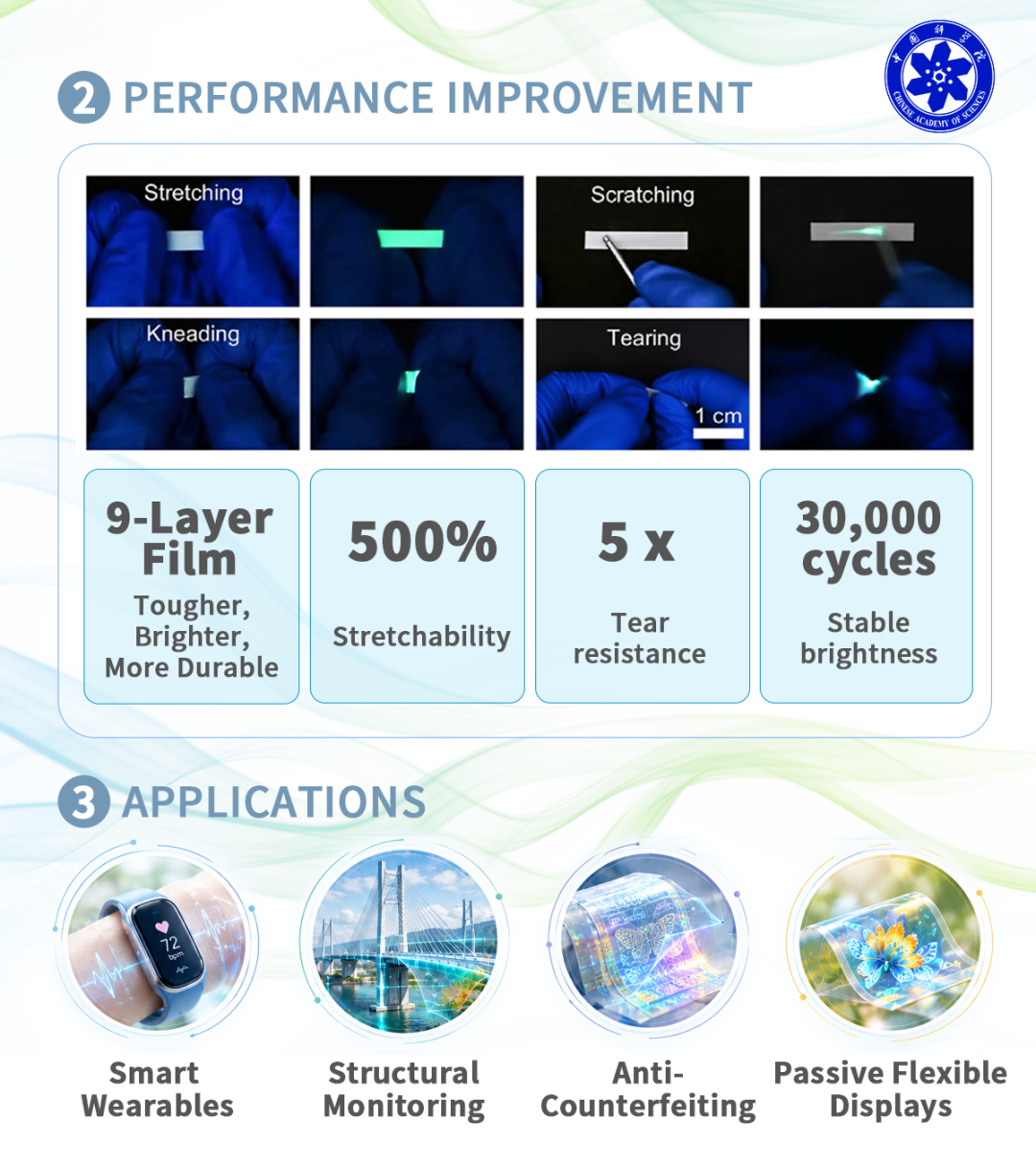
This is known as mechanoluminescence—the ability to convert mechanical force directly into light signals. Such materials could have applications in smart wearables, structural monitoring, anti-counterfeiting and encryption.
但要让材料既会发光,又经得起反复拉伸,并不容易。传统柔性发光薄膜通常以聚二甲基硅氧烷(PDMS)为基体,虽然柔软有弹性,却容易在反复受力后产生裂纹,影响使用寿命。
But making a material that is both light-emitting and durable enough to withstand repeated stretching is not easy. Traditional flexible light-emitting films often use polydimethylsiloxane (PDMS) as the base material. Although soft and elastic, they can develop cracks after repeated mechanical stress, shortening their service life.
中国科学院兰州化学物理研究所科研团队从蛤蜊铰链的分层结构中获得启发,设计出一种仿生多层复合薄膜,让材料更耐拉、更抗撕裂,发光性能也得到提升。
Inspired by the layered structure of clam hinges, a research team from the Lanzhou Institute of Chemical Physics, Chinese Academy of Sciences, developed a bioinspired multilayer composite film that is more stretchable and tear-resistant, while also delivering brighter light emission.
蛤蜊的“铰链”为什么这么耐用?
Why Is a Clam's "Hinge" So Durable?
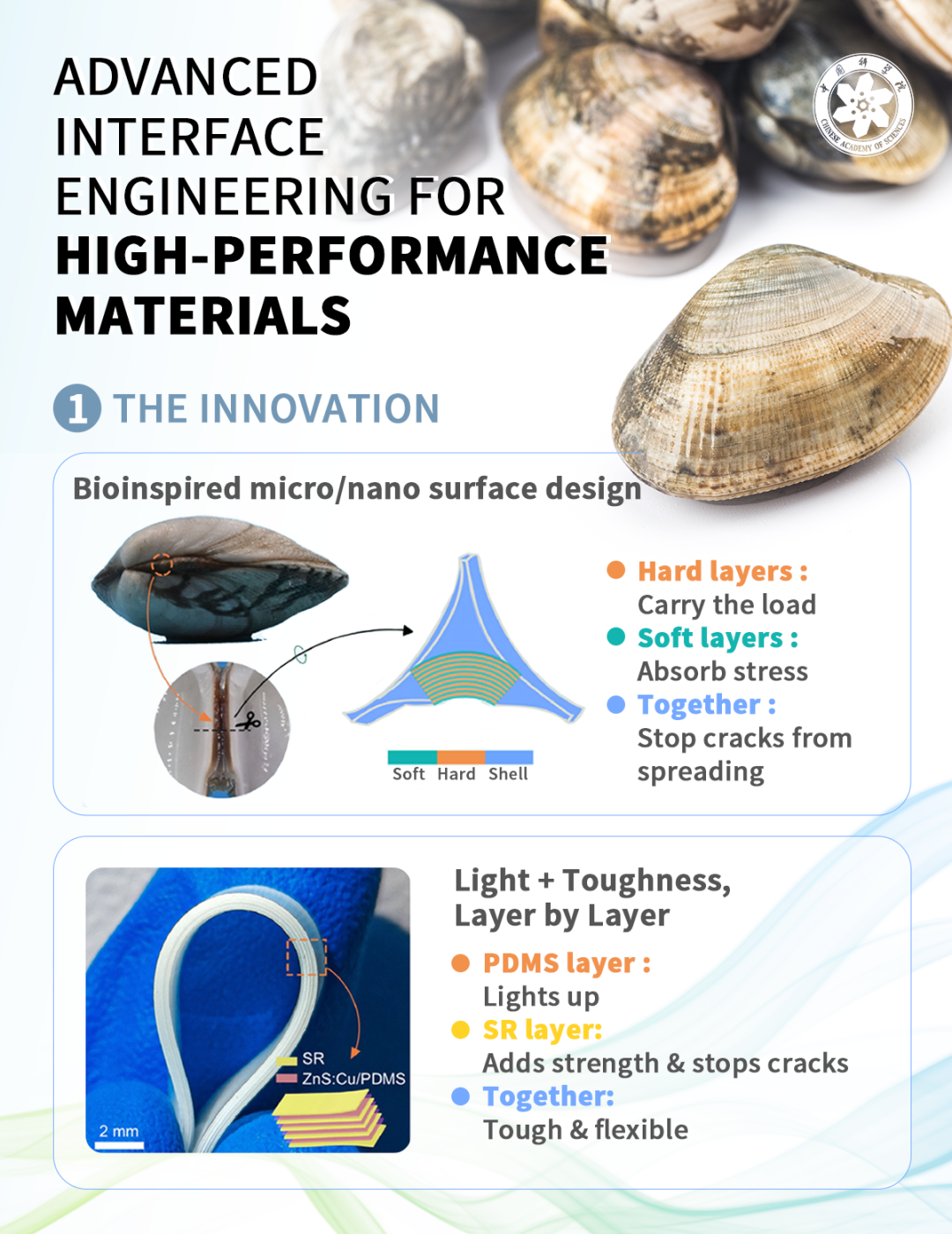
蛤蜊的两片贝壳可以开合数十万次,铰链却不容易损坏。秘密就在于它由软硬相间的层状结构组成:硬层承受力量,软层则像“缓冲带”一样分散应力。
A clam's two shells can open and close hundreds of thousands of times, yet its hinge remains remarkably durable. The secret lies in its alternating hard and soft layers: the hard layers bear the load, while the soft layers act like "cushion zones" to distribute stress.
中国科学院国际合作局出品
Produced by Bureau of International Cooperation, Chinese Academy of Sciences
当硬层出现裂纹时,裂纹扩展到软层后会受到阻碍,不容易继续蔓延。即使局部受损,也不容易让整个结构失效。
When a crack forms in a hard layer, its growth is hindered when it reaches a soft layer, preventing it from spreading further. As a result, even localized damage is less likely to cause the entire structure to fail.
把蛤蜊的结构变成“千层蛋糕”
Turning the Clam's Structure into a "Layer Cake"
科研人员借鉴这一思路,将PDMS发光层与高韧性硅橡胶(SR)层交替叠加,制成类似“千层蛋糕”的薄膜——一层负责发光,一层负责抗裂。
Inspired by this design, the researchers alternated PDMS light-emitting layers with tough silicone rubber (SR) layers, creating a film resembling a "layer cake"—one layer for light emission, the next for crack resistance.
在总厚度约1毫米的薄膜中,9层结构的综合性能最佳:可以拉伸至原长的5倍,抗撕裂能力提升近5倍;反复拉伸3万次后,仍能稳定发光。
For a film about 1 mm thick, the nine-layer structure delivered the best overall performance. It could be stretched to five times its original length, with tear resistance improved by nearly fivefold. Even after 30,000 stretching cycles, it continued to emit light reliably.
发光性能,不只是“发光粉”的功劳
Light Emission Isn't Just About the "Light-Emitting Powder"
研究还发现,力致发光材料的性能,不只是“发光粉”的功劳,材料本身的结构同样重要。通过优化层状结构,就能同时提升韧性、拉伸能力和发光性能。
The study also revealed that the performance of mechanoluminescent materials depends on more than just the "light-emitting powder"—the structure of the material itself matters, too. By optimizing the layered architecture, researchers can simultaneously improve toughness, stretchability and light-emitting performance.
中国科学院国际合作局出品
Produced by Bureau of International Cooperation, Chinese Academy of Sciences
从蛤蜊铰链的一层层结构,到实验室里的“千层薄膜”,自然界的结构智慧正为柔性材料设计带来新思路——让材料不仅会发光,还能经得起反复“折腾”。
From the layered structure of a clam hinge to a "layer cake" film in the laboratory, nature's structural wisdom is inspiring new approaches to flexible materials—making them not only light up, but also stand up to repeated stretching and stress.